Bulletin of the Atomic Scientists, September 10th, 2026
Posted: 11th September 2026
September 10, 2026
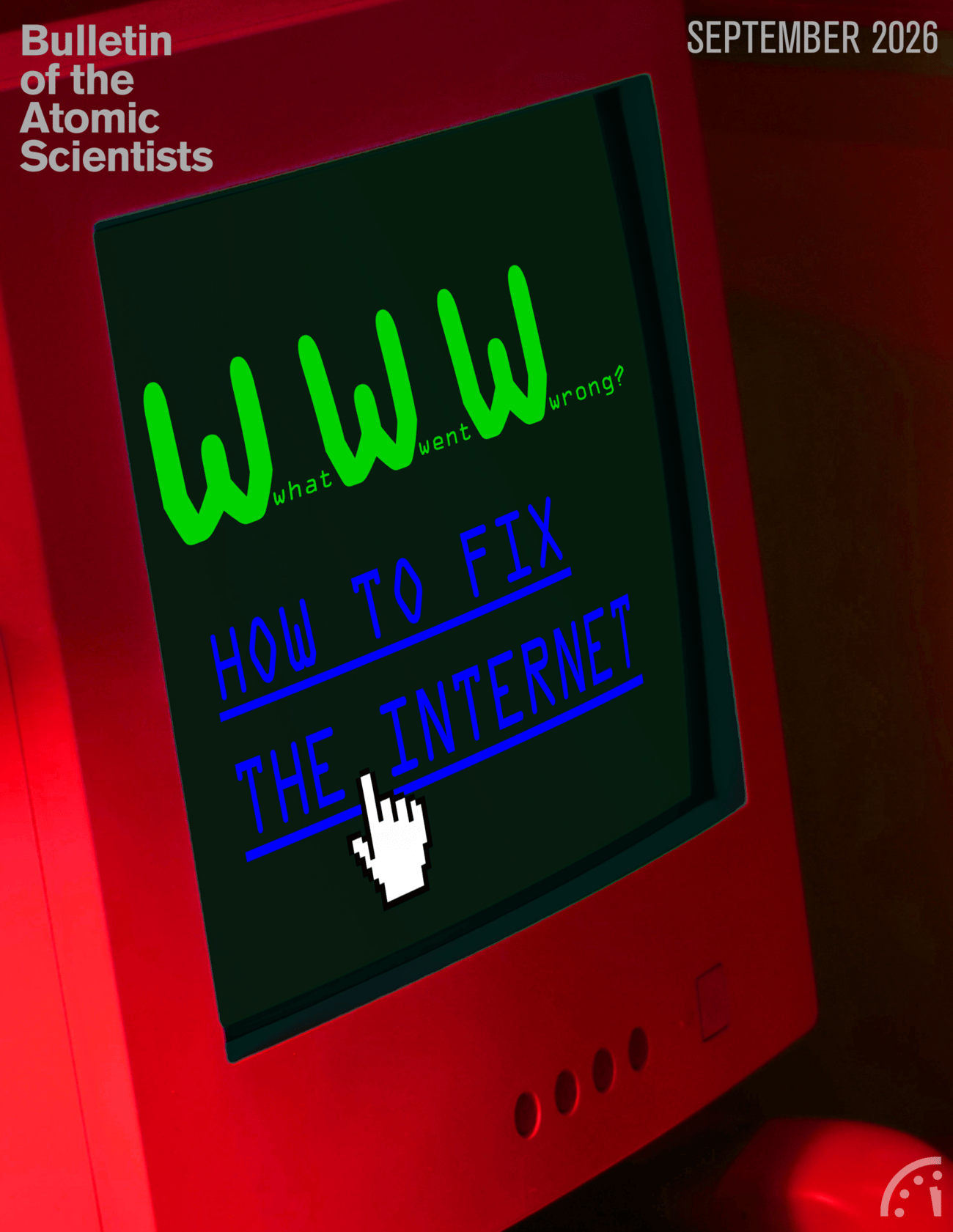
(Photo illustration by Thomas Gaulkin)
Introduction: What went wrong with the internet—and how do we fix it
What went wrong with the internet, and how do we fix it—particularly in an era when data centers and AI seem poised to overrun the Earth? The premise of the September 2026 Bulletin magazine is straightforward—but the diagnoses and the proposed solutions are not, writes Dan Drollette Jr. One thing our essayists do seem to agree on, however, is that things are getting worse. Read more.
The dirty parts of the computing world, revisited
Ten years ago, Nathan Ensmenger argued in the Bulletin that the environmental costs of computing were the dirty little secret of the digital economy. That secret is now out: Data centers have become the subject of public hearings, political campaigns, and congressional legislation. But the new awareness has fixated on the measurable impacts while overlooking the bigger picture about what a data center actually is: a factory. And like every factory, a data center is a means of organizing labor, capital, land, and political power. This Bulletinmagazine article is available to all readers for a limited time.
Indian nuclear weapons, 2026
“India continues to modernize its nuclear arsenal, with several new weapon systems fielded in recent years and several more under development to complement or replace existing nuclear-capable aircraft, land-based delivery systems, and sea-based systems,” write the staff of the Federation of American Scientists’ Nuclear Information Project, Hans M. Kristensen, Matt Korda, Mackenzie Knight-Boyle, and Eliana Johns. “We estimate that India may have produced enough military plutonium for 140 to 225 nuclear warheads and might have assembled up to 190.” Read more.
Advertisement
VIDEO
Inside an AI-powered lab trying to replace scientists
Materials R&D company Radical AI is building self-driving labs in New York City where robots synthesize and test materials while AI decides what experiment to run next. The Bulletin’s Rambo Talabong went inside the lab to see how it works and ask whether AI can do science without scientists. Watch here.
UPCOMING EVENT
Exclusive pre-sale: Strathmore and the Bulletin present Kronos Quartet’s A Hard Rain
The Grammy-winning Kronos Quartet, the Bulletin’s Artist-in-Residence, will take the stage at the Strathmore in North Bethesda outside Washington, DC for a concert on the evening of Tuesday January 26, 2027.
The concert kicks off next year’s programming honoring 80 years since Martyl Langsdorf created the Doomsday Clock in 1947. The Bulletin’s Arts + Science Initiative carries forward her legacy of bringing together artists and scientists to push for change, through programming like this concert.
Get exclusive pre-sale access to tickets for the concert by using the code “BULLETIN” on the Strathmore site. Learn more.
UPCOMING EVENT
Conversations Before Midnight speakers announced
Existential risks are on the rise. Can our leaders meet the moment?
At the Bulletin’s annual gathering, Conversations Before Midnight, on November 12th in downtown Chicago, we’ll take a deep dive into that question with former Director of National Intelligence Avril Haines and Chicago Public Media CEO Melissa Bell.
Tickets start at $75 for the Reception and Keynote Discussion. At a time when science is under attack, your support helps keep the Bulletin’s 80-year legacy of fact-based journalism alive. Purchase tickets here.
Recent articles
- The AI stack’s architecture is a constitution. It’s being written without us
- Newly created viruses are a warning. We still have a window to stop AI-enabled bioweapons
- Climate change is exposing nuclear power’s reliability problem
- Defeated by physics: The science behind Golden Dome’s space-based interceptors doesn’t add up
- How drones reinvented the proxy war
ADVERTISEMENT
Are you researching policy-relevant nuclear security issues? This new grant could fund your research.
The Stanton Nuclear Security Fund is launching a new nuclear security grant program. The program is open to researchers at US non-profit organizations conducting nuclear security research on topics such as nuclear war, nuclear terrorism, nuclear proliferation, nuclear weapons, deterrence, nuclear force posture, nuclear use doctrine, and security assurances, and, as it relates to nuclear security, nuclear energy.
For more information on how to apply, email Jessica Coakley at [email protected].
Application deadline is October 1st.
Your gift fuels our mission to educate and empower. Together we will work to ensure science serves humanity.
Give today