
This Peace Day: What does war have to do with the environment?
Posted: 22nd September 2026
Today is the International Day of Peace. It is a day to call for an end to war — but also to ask a bigger question: What does a just and sustainable peace actually require?
Peace is more than the absence of fighting. Communities also depend on clean water, healthy land, functioning ecosystems, secure livelihoods, and the wider conditions that sustain life.
Yet conversations about war and peace and conversations about climate and environmental breakdown are still too often kept apart.
Much discussion about climate and security asks how environmental pressures may contribute to conflict. We also need to ask the question in the other direction:
Their environmental impacts can begin long before fighting starts and continue long after it ends: through military bases, weapons production and testing, training exercises, energy and resource use, toxic contamination, nuclear weapons, armed conflict, and the environmental legacies left behind.
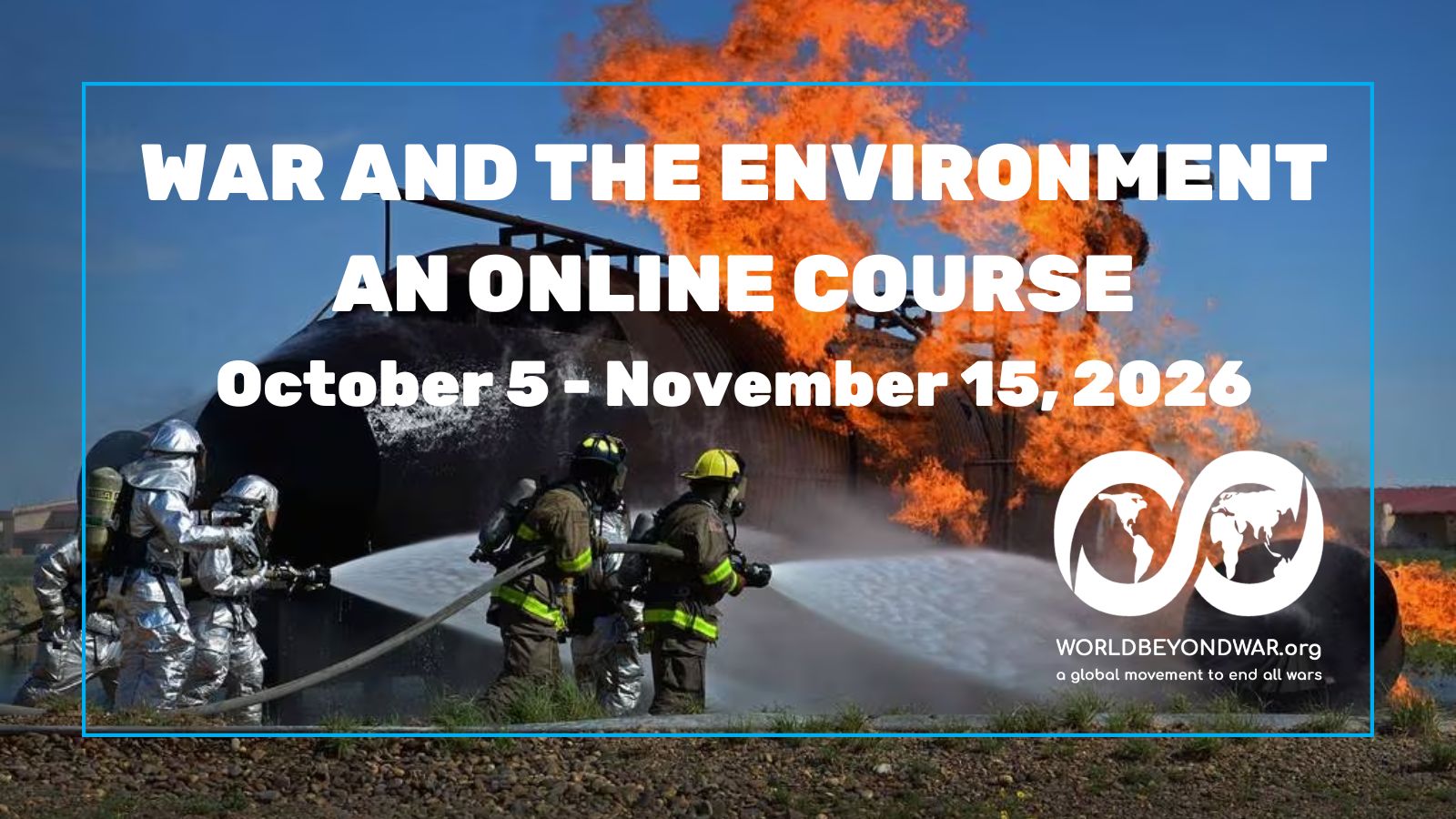
That is the focus of World BEYOND War’s six-week online course:
Substantially updated for 2026
We have run War and the Environment before. For 2026, we are updating and strengthening it. The refreshed course brings in current research and examples, updated resources, a clearer before–during–after lens, and greater attention to environmental justice, military pollution and emissions, nuclear legacies, accountability, and practical pathways for action.
The aim is not simply to document damage, but to connect understanding with action.
Special 2026 feature: Live Q&A with Abby Martin
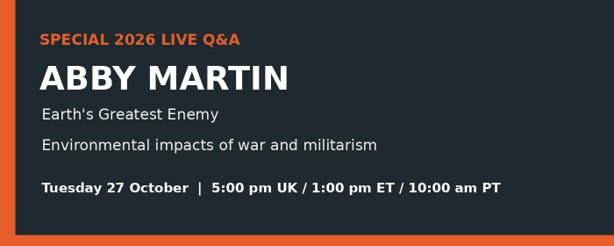
Course participants will have the opportunity to join filmmaker and journalist Abby Martin for a special live conversation around Earth’s Greatest Enemy and the environmental impacts of war and militarism. This will be a live conversation rather than a formal lecture, giving participants the opportunity to bring their questions and engage directly.
What will you explore?
- How war and preparations for war affect people, communities, land, water, climate, ecosystems, health, and livelihoods.
- The environmental consequences of military bases, weapons production, pollution, resource use, nuclear weapons, armed conflict, and their aftermath.
- Who bears these costs, whose experiences receive least attention, and why many environmental harms remain hidden or weakly addressed.
- What can be done through education, organising, policy, accountability, demilitarisation, environmental protection, and nonviolent action.
What changes when war and militarism are understood as part of the climate and ecological problem, rather than environmental harm being treated simply as a side effect of war?
Meet the facilitator team
Participants will learn alongside facilitators bringing experience from different parts of the world across peacebuilding, environmental issues, militarism, climate, education, research, and activism.
Peacebuilding, human rights, social justice, education, and grassroots activism.
Military pollution, PFAS contamination, military bases, and environmental harm.
▶ Watch Pat’s short video on why these issues matter and why he hopes you will join the course.
Military emissions, climate governance, environmental law, peace, and militarism.
Dr Alicia Cabezudo — Argentina
Peace education, culture of peace, human rights, citizenship, and post-conflict education.
Additional guest facilitators will be announced shortly.
How does the course work?
The course is fully online and flexible. A new module opens each week, combining readings, videos, case studies, discussion, reflection, and optional assignments.
- Six weekly modules
- Three optional live Zoom sessions
- Approximately 3–6 hours per week, depending on how deeply you choose to engage
- Certificate of Completion for participants who complete the weekly assignments
- No prior specialist knowledge required
The course is for people working in — or simply interested in — peace, anti-war organising, climate change, environmental protection, environmental justice, education, sustainable development, research, policy, activism, and social change.
Standard fee: $100. Sliding-scale registration starts at $25. Higher contributions help make participation possible for those who might otherwise be unable to join.
Building peace also means protecting the conditions that sustain life.
On this International Day of Peace, we invite you to explore a connection that deserves far more attention: war, peace, and the environment.
In peace and solidarity,
Phill Gittins, PhD
Education Director, World BEYOND War
P.S. You can also help someone else take part. If you would like to help cover the cost of a place for someone who may not be able to afford the full fee, you can make a contribution here. Please add a note that your donation is to support access to the War and the Environment course.