
‘The tide is turning’: Palestine solidarity’s impact on British politics
Posted: 7th October 2026

‘The tide is turning’: Palestine solidarity’s impact on British politics
British Palestinian Committee director on what divestment and electoral pressure have achieved – and where work remains
By Nandini Naira Archer & Sara Husseini • 7 Oct 2026 View in browser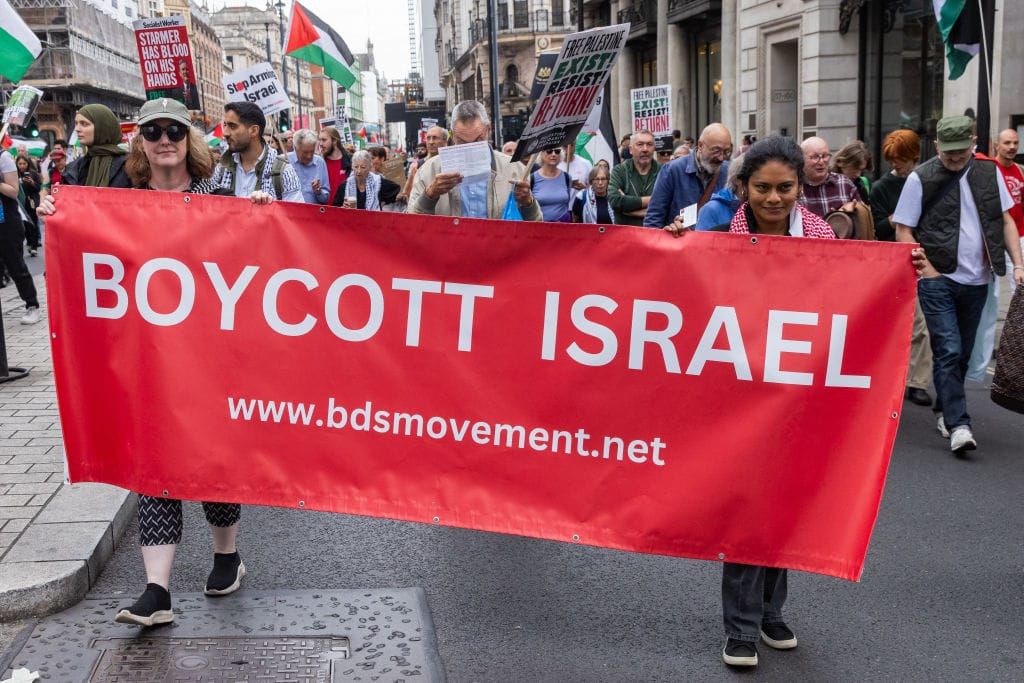
Three years after October 2023, Palestine solidarity campaigning has become an increasingly visible force in British politics. From mass demonstrations and electoral organising to boycott and divestment campaigns, activists have sought to turn public opposition to Israel’s assault on Gaza into political and economic pressure.
There have been some shifts in government policy, including sanctions relating to Israeli settlements, while councils, trade unions and other institutions have faced growing pressure to divest from companies linked to Israel. But Palestine Action has also been proscribed, with dozens of activists arrested or imprisoned, and campaigners argue that this and the UK’s continuing military, economic and diplomatic support for Israel show how far there is still to go.
openDemocracy spoke to Sara Husseini, director of the British Palestinian Committee, about what has genuinely changed over the past three years, the role of the Palestinian-led boycott, divestment and sanctions (BDS) movement, and where campaigners are likely to focus next.
This interview has been edited for length and clarity.
The next election is only three years away, and we are determined toprevent the rise of the far right. To do that, we want to recruit 500 new monthly donors by the end of 2026. We’re a third of the way there – but still have a long way to go
Will you be part of the movement to fight the far right, with a monthly donation today?
Become a regular supporterNandini Naira Archer: How different is the political conversation around boycotts, divestment and sanctions in Britain now compared with before October 2023? What has genuinely shifted, rather than just changed rhetorically?
Sara Husseini: The horrors of the past three years of Israel’s genocidal assault on the Palestinian people in Gaza have only increased the number of people of conscience across the UK and globally engaging in campaigns for boycotts, divestment and sanctions to apply economic pressure on Israel.
As many as 34 councils in England and Wales have now committed to divesting their pension funds from companies complicit in Israel’s grave war crimes and crimes against humanity. Just last month, the Trades Union Congress, representing upwards of five million workers across the UK, voted to endorse the Palestinian-led BDS movement and bring a complete end to the arms trade with Israel.
While the UK government continues to formally distance itself from BDS as a movement – against the backdrop of a coordinated and sustained attack on non-violent resistance – the measures recently announced by the foreign secretary constitute sanctions, albeit limited ones.
Steps like these are first and foremost an obligation under international law. But they also reflect the public pressure that has compelled this Labour government to shift its position – a message previous governments failed to listen to.
 openDemocracy•Aman Sethi
We’re back with a new season of In Solidarity – now available in video! Watch on YouTube or listen wherever you get your podcasts.
YouTubeListen NowIf we look to apartheid South Africa, for example, the British government was one of the last to respond by sanctioning the apartheid government. So the shift in the UK’s position on sanctions indicates that the tide really is turning.
Where do you think Palestine solidarity campaigning has had the clearest tangible impact on UK politics or policy over the past three years, and where has it struggled to translate mass public mobilisation into political change?
The Palestine solidarity movement has been successful in making the struggle for Palestinian liberation an electoral issue here in the UK – at a national level, but also locally, as the Vote Palestine campaign in this year’s council elections demonstrated.
These successes have meant politicians in elected office know that they at least have to be seen to be taking action on Israel’s grave war crimes and crimes against humanity, as illustrated by Andy Burnham’s apology for the Labour Party’s initial response to Israel’s military action in Gazaand the recent announcement of sanctions relating to illegal settlements.
However, the UK continues to provide considerable economic, military and diplomatic support to Israel. There therefore remains a significant democratic deficit between the demands of the British public and the political class.
 openDemocracy•Ethan Shone
 openDemocracy•Sian Norris
 openDemocracy•Guilherme Klein
There is also a rightward surge in the UK, as there is across Western Europe, and broadly speaking this politics is more hostile to the Palestinian cause. There is more work to be done on strategising around and resisting this shift, electorally and beyond.
We’ve seen the UK government take some measures relating to settlements, companies and arms, while campaigners have argued these fall far short of what is needed. How significant have those changes been from your perspective, and how much do you think sustained campaigning and public pressure contributed to them?
The changes in government policy do not go nearly far enough to create material change on the ground in Palestine or to meet Britain’s obligations under international law. But they do represent a significant shift in tone.
That says a lot about the broader shift in public consciousness around the Palestinian struggle, the power of sustained public pressure and Israel’s growing isolation internationally.
What is required now are comprehensive sanctions on the Israeli state, including Israeli ministers and officials responsible for grave violations of international law, alongside support for the enforcement of international arrest warrants for alleged war crimes and crimes against humanity.
A two-way ban on the arms trade is essential, including the provision of F-35 components to Israel through the global spare-parts pool, as well as other forms of military cooperation and intelligence sharing.
These are measures any government committed to upholding the international legal framework should be prepared to take, not least in the context of the ongoing genocide in Gaza.
After witnessing three years of genocide livestreamed to their phones, people in the UK remain attentive to this issue and will continue to hold the government accountable, particularly since Britain bears a specific historical responsibility for the original dispossession of the Palestinian people more than a century ago.
What role does BDS play now within the broader Palestine solidarity movement? Has its strategy, audience or political importance changed as the movement has grown?
Boycotts have long been used by oppressed communities as a tactic to resist injustice and mobilise international support for their cause. They are one of the tools available to people who want to protest injustice and make ethical decisions about where their wages are spent. They provide an opportunity for collective and sustained action that is not contingent on government positions.
The Palestinian-led BDS call emerged more than 20 years ago and continues to play a vital role within the solidarity movement. It has always been one tool within the broader campaign for Palestinian freedom, justice and equality.
It has done a great deal to raise awareness of abuses committed by Israel and has provided a means for ordinary people to express their opposition to the killing, forced displacement and incarceration of millions of Palestinian women, men and children in their own homes and homeland.
There is no doubt that the shifts we are seeing in the positions of governments such as the UK’s are a result of public pressure, including boycott and divestment campaigns, solidarity marches and constituents consistently contacting their MPs, particularly over the past three years.
Boycott, divestment and sanctions are three different approaches that can be used by different actors – from individuals to institutions and governments – but work in tandem to advance Palestinian rights.
People are also much more aware of the relationship between the Palestinian struggle and other human and political rights, including the importance of protecting civil liberties and the right to protest.
The so-called ‘BDS bill’, which attempted to prevent public bodies from making ethical decisions about procurement and investment and fell with the Conservative government in 2024, highlighted the dangers of legislation that could be used to shut down protest across a much wider range of social and political justice issues, from fossil fuels and weapons manufacturing to workers’ rights.
As we have always maintained, BDS is a necessary tactic, but it alone cannot bring about Palestinian liberation. It is part of a broader strategy and should be seen in that light.
What are the biggest political obstacles now to further action in Britain, and where do you think campaigners are likely to focus their pressure next?
On an ideological level, British politicians across the political spectrum often discuss illegal settlements as though they are the enterprise of an extreme fringe of Israeli society, rather than foundational to the state’s colonial architecture and expansionist policy.
This has provided a basis for the UK government to attempt to justify its continued support for Israel beyond the limited sanctions that have been imposed.
It is imperative that the Palestine solidarity movement dispels this myth and makes plain what support for Israel means: the aiding and abetting of a settler-colonial project aimed at gaining the maximum amount of territory on and around historic Palestine with the fewest number of Palestinians on that land.
There is also an alarming effort by elements of the political and media establishment to erase or forget the ongoing genocide – to approach the struggle in Palestine as though nothing has changed since October 2023, while turning a blind eye to colonial expansion across Palestine and continuing ceasefire violations in Gaza.
Campaigners are working hard to ensure these ongoing atrocities are not forgotten, and that accountability means more than targeting the settlement project alone, but rather takes aim at a state that would commit genocide against a besieged and occupied population.

More like this

Less like this
KEEP READING
‘The tide is turning’: Palestine solidarity’s impact on British politics
Un desalojo empuja a España a elecciones anticipadas

How one eviction pushed Spain to a snap election