
Bulletin of the Atomic Scientists, October 8th 2026
Posted: 8th October 2026
October 8, 2026
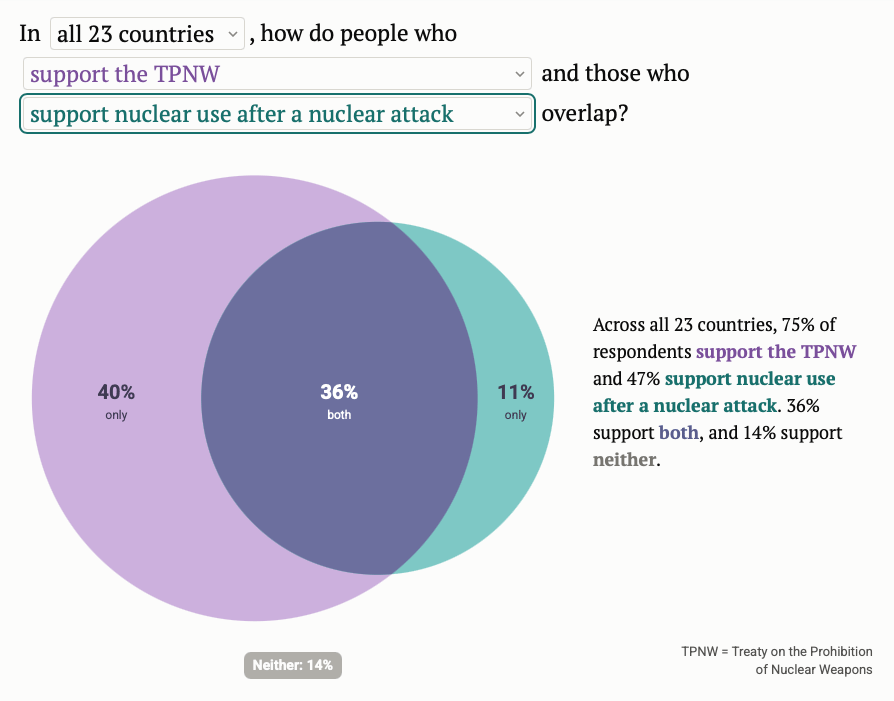
Interactive graphic from the article.
The nuclear paradox: Why the world wants both deterrence and disarmament
A landmark 23-country study of more than 26,000 respondents reveals that a majority worldwide embraces both nuclear deterrence and disarmament. Study authors Lauren Sukin, J. Luis Rodriguez, and Stephen Herzog argue that the results expose a pragmatic—rather than confused—flexibility that gives policymakers rare leeway for creative diplomacy. Read more.
AI doom has a precision problem
“The uncertainty is not just about how likely a catastrophic event would be but also the mechanisms through which those outcomes would emerge,” writes author Sarah Kreps. “Nuclear weapons offered more straightforward ways to connect causes to consequences using variables like weapon yield, population density, and location. AI has no comparable set of established causal relationships.”
“Until there is more clarity on these basic questions, neither developers nor policymakers can credibly establish a quantitative risk assessment, let alone what actions would trigger which risks and to what degree.” Read more.
Annie Jacobsen’s road from Siberia to Armageddon is paved with bad assumptions
Following recent reports of a death at a secretive Siberian disease research lab, author Annie Jacobsen has become a sought-after media interview. Some interviewers are now casting Jacobsen’s new bestseller on biological war as almost a “true story.” But authors Filippa Lentzos and Yong-Bee Lim argue that the catastrophe Jacobsen inaccurately presents in Biological War: A Scenario, in which almost every variable takes its worst possible outcome, cannot tell us which biological threats are most plausible or where scarce resources should go. Read more.
Advertisement

OCTOBER 14 | VIRTUAL EVENT
The Web World Wide: The Impact of the Internet
Even though the internet has made some aspects of life better, do we need to log off to fix climate change? To protect our grid and our information? To maintain the very nature of society? On October 14, join the Bulletin as we debate whether the costs of the internet have begun to outweigh the benefits. Register.
OCTOBER 20 | CHICAGO EVENT
Watch the PBS Documentary BOMBSHELL in Chicago and hear from the filmmakers
BOMBSHELL investigates how the US government censored reporting to control the narrative about the atomic bombings of Japan, while minimizing the horrific human toll. On October 20, join us for a screening of the film, followed by a discussion and Q&A with the filmmakers and experts. Register.
Recent articles
- AI doesn’t need ‘superintelligence’ or evil intent to start a nuclear war
- Indian nuclear weapons, 2026
- Ruth Tucker joins the Bulletin
- How the bad science of AI doomerism is good for big business
- M. Patrick Yingling joins the Bulletin’s Governing Board
Your gift fuels our mission to educate and empower. Together we will work to ensure science serves humanity.
Give today