
Iran is Binyamin Netanyahu’s war. Will Donald Trump end it?
Posted: 25th March 2026
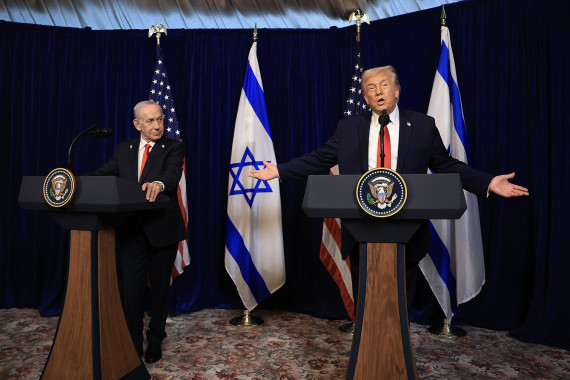
It is now glaringly obvious that Israel and the United States seriously underestimated the Iran war.
While Donald Trump and Binyamin Netanyahu succeeded in assassinating the supreme leader, they failed to deliver regime termination; the popular revolt they hoped for didn’t materialise, and the Iranian government continues, showing little sign of defeat or willingness to negotiate.
In particular, the US and Israel underestimated Iran’s power to bring to a halt the shipping of much of the world’s oil. The Iranian Revolutionary Guard Corps (IRGC) have had decades to prepare a survivable means of closing the Strait of Hormuz, and it should be assumed that it can maintain the closure for weeks, or even months, regardless of military actions taken by the US and Israel.
These actions so far include a recent round of US air attacks that used powerful ground-penetrating weapons to destroy anti-ship missiles in deep bunkers. Whether these are effective is dubious; the IRGC will also have gamed the consequences of these and other likely moves and prepared appropriately.
The war has spread rapidly across the region over the past three weeks, and Netanyahu this week suggested a need for ground troops in Iran. Yet despite Israel’s central role in the Iran War and its deadly actions in Lebanon and the Occupied West Bank, Western media attention is heavily focused on Trump.
This may in part be down to the US president’s personal attention-seeking, but it is a mistake. Netanyahu started this war, and the Israeli attack on Iran’s South Pars Gas Field earlier this week will most likely prolong it.
As I wrote last week, Netanyahu is highly unlikely to entertain any deal with Tehran short of total Iranian surrender. Israel must achieve regime termination and full control of Iran, extending to the detailed long-term oversight of its post-war military capabilities, especially on nuclear weapons development. Anything less would allow any post-war surviving power base to prioritise the development of a crude nuclear capability.
That means any chance of an early end to the war will depend on the US and Trump’s position, where an element of political uncertainty is emerging.
For a start, there is now a deep reluctance among the US’s Western allies to become more involved in the war. Trump’s evident disapproval will cut little ice with leaders horrified at the unfolding global economic disorder, particularly with older politicians still harbouring distant memories of the 1973/74 oil price crisis. In the UK, it has already been forecast that the war will lead to a £330 increase in typical annual household energy bills, according to a new calculation from energy consultancy Cornwall Insight.
Two further developments this week are relevant and help to undermine Trump’s position.
The first is that the US and Iran were reportedly engaged in negotiations to avoid an escalation to the conflict when Netanyahu precipitated the war. A participant in the talks was Britain’s national security adviser, Jonathan Powell, who was said to be surprised at the extent of the Iranian offer and felt a deal was in sight.
The Guardian reported: “Two days after the talks ended, and after a date had been agreed for a further round of technical talks in Vienna, the US and Israel launched the attack on Iran.”
The other development is the sudden resignation of Joe Kent – formerly seen as a Trump loyalist – from his post as director of the US National Terrorism Centre. Writing on X this week, Kent said he could not “in good conscience support the ongoing war in Iran” because Iran posed “no imminent threat to our nation.”
Trump’s core domestic support base – around 30% of voters – is still holding reasonably firm, especially among MAGA Republicans, but his popularity is slipping among the general public. His net approval on a three-week moving average has hovered around -16 to -18 over the past six months, down from 2 this time last year.

In short, the Trump administration is in trouble, and its ratings could get worse still if it fails to gather the military power needed to open the Strait of Hormuz. The difficulty for the Pentagon is that the substantial forces it originally amassed for the war were concentrated on the air power needed for quick regime change and the destruction of weapons and materiel, while it now needs naval and amphibious forces.
This does much to explain Trump’s bitterness and frustration at the lack of European military support for controlling the Strait. It also leaves the US Navy and Marine Corps with the unenviable task of reconfiguring the military posture away from an air attack to a maritime operation close to an enemy state.
Worse still for the Pentagon, naval forces and Marine Corps units deployed to the Gulf’s confined waters will provide a welcome target for the IRGC – one especially suited to one of its few surviving advantages: a near-unlimited supply of thousands of short-range armed drones. More still are being produced by the hundreds in backstreet workshops across the country.
This is one of the elements that will determine what happens in the war in the next month. Knowledgeable Western military analysts accept the accuracy of recent media reports that the IDF needs at least three more weeks of continuing airstrikes to fully cripple Iran’s military capabilities.
That may be wishful thinking on the part of the IDF, especially with its simultaneous assault in Lebanon, but it is also paralleled by a rapid re-ordering of US forces necessary if it is to control the Strait of Hormuz.
Are we therefore into a long crisis with the potential to slide into a worldwide economic catastrophe? Perhaps not.
Ignore the Trumpian bombast and the showmanship of his war secretary, Pete Hegseth, and there are signs that people in and around the White House and the Pentagon know that Trump is in a mess that could cost the Republican Party dear for years to come. By far, Trump’s best political option would be to declare victory – whether or not he has achieved anything like it – and pull out.
This scenario could become more likely if European and other allies put intense private pressure on the influential people in Washington pulling the strings around Trump, especially if they withdraw current support, such as forward basing. Admittedly, it would still leave the loose cannon of Binyamin Netanyahu, but it would certainly be a start.